Openings
Beginner (Michy)
- Most important point is the 5-point
- Make an outfield point
- Fight for a good point
- Break the mountain
- Keep at least 3 checkers on the midpoint
- Double hit is Tiger Play!
- Attacking with 8 checkers is weak (e.g. split when opponent has only 8 checkers)
- Attacking with 10 checkers is strong
- Split against the stripped 8-point
- Split against a prime
- Never split facing a blitzing structure (including 53)
- Hit and split
Intermediate (Michy)
- Making a point is better than hitting loose
- Avoid your opponent's stacked points
- Counter an advanced anchor with an advanced anchor
- Every time you roll an ace, think about slotting
- Make sure you can play a six (pay attention to back checkers)
- The best builder is on your nine point
Advanced (Michy)
- A builder cannot work with only one dice
- Do you feel good about your priming battle?
- Who has the better prime? Who can extend more easily? Who trails in the race?
- Strategy for priming favorite: keep building your prime. Forget about your back checkers.
- Strategy for opponent: split as soon as possible.
Double Tiger Play
Hitting loosely on e.g. 5 and 4:
- You hit two checkers
- 2 blots in your home board ≈ 20 return shots
- Good potential to make inner-board points quickly if you are missed
Doubling
Racing Guideline (Magriel)
Magriel provides a guideline for offering or accepting the cube in a racing situation:
In a long race (about 100 pips) a player should be a minimum of 10 pips in the lead to offer a double, or a maximum of 13 pips behind to accept a double.
PRAT
PRAT stands for Position, Race, Threats (+ Gammonish). These factors determine whether to offer, accept, or refuse a double.
1. Position
Which inner board points you have that the opponent does not:
- 5th point = 0.75
- 4th point = 0.5
- 3rd point = 0.25
2. Race
Formula: pips ahead / 16
- 16 pips = 1 point
- 12 pips = 0.75
- 8 pips = 0.5
- 4 pips = 0.25
- 1 pip = 0.0625
3. Threats
Formula: decisive rolls / 9
- ≥ 9 rolls = 1 point
- 8 rolls = 0.88
- 4 rolls = 0.44
4. Gammonish
- 30% gammons = 0.5 points
- 20% gammons = 0.33
- 10% gammons = 0.17
PRAT Decision
- ≥ 2 → Double
- ≥ 3 → Pass
When PRAT doesn't work
- Holding games
- Solved races (use Isight or Keith count)
- Prime vs prime
- Points behind an anchor
If there are any market losers you should double.
Olsen Scale
For the doubler — do you have a clear edge in 2/3 plans?
- Race: clear racing lead (12+ pips)
- Prime: good priming structure?
- Blitz: threatening a blitz?
Threats are mandatory when considering doubling. Priming is special — with a very clear priming edge you can send the cube even without other advantages.
For the taker — do you have at least one good source of counterplay?
- Race
- Prime
- Blitz
- Contact (e.g. holding game — defensive plan, only a factor for the taker)
Seven Red Flags to Drop Cubes
- Lack of development
- Hoping to get lucky
- Too many gammons (at some scores)
- Crunched board
- Too much work to do (many back checkers, many blots, etc.)
- Too many threats (completing a strong prime, etc.)
- Poor timing
Match Equity Table (Kazaross-XG2)
The MET gives the match-winning chance for the player whose away score is in the row, given the opponent's away score in the column. It's the foundation for every cube decision in match play — take points, doubling windows, and drop equities all derive from it. Row 1 and column 1 are the Crawford / post-Crawford game.
This is the Kazaross-XG2 MET: XG rollouts for short matches and GNUbg full rollouts past 9-away. Original article →
Compact — 1-away to 9-away
| ↓ you / opp → | 1 | 2 | 3 | 4 | 5 | 6 | 7 | 8 | 9 |
|---|---|---|---|---|---|---|---|---|---|
| 1 | 50.0 | 67.7 | 75.1 | 81.4 | 84.2 | 88.7 | 90.7 | 93.3 | 94.4 |
| 2 | 32.3 | 50.0 | 59.9 | 66.9 | 74.4 | 79.9 | 84.2 | 87.5 | 90.2 |
| 3 | 24.9 | 40.1 | 50.0 | 57.6 | 64.8 | 71.1 | 76.2 | 80.5 | 84.0 |
| 4 | 18.6 | 33.1 | 42.9 | 50.0 | 57.7 | 64.3 | 69.9 | 74.6 | 78.8 |
| 5 | 15.8 | 25.6 | 35.2 | 42.3 | 50.0 | 56.6 | 62.6 | 67.8 | 72.5 |
| 6 | 11.3 | 20.1 | 28.9 | 35.7 | 43.4 | 50.0 | 56.3 | 61.6 | 66.8 |
| 7 | 9.3 | 15.8 | 23.8 | 30.1 | 37.4 | 43.7 | 50.0 | 55.5 | 60.8 |
| 8 | 6.8 | 12.5 | 19.5 | 25.4 | 32.2 | 38.4 | 44.5 | 50.0 | 55.4 |
| 9 | 5.6 | 9.8 | 16.0 | 21.2 | 27.5 | 33.2 | 39.1 | 44.6 | 50.0 |
Full table — 1-away to 15-away
| ↓ you / opp → | 1 | 2 | 3 | 4 | 5 | 6 | 7 | 8 | 9 | 10 | 11 | 12 | 13 | 14 | 15 |
|---|---|---|---|---|---|---|---|---|---|---|---|---|---|---|---|
| 1 | 50.0 | 67.7 | 75.1 | 81.4 | 84.2 | 88.7 | 90.7 | 93.3 | 94.4 | 95.9 | 96.6 | 97.6 | 98.0 | 98.5 | 98.8 |
| 2 | 32.3 | 50.0 | 59.9 | 66.9 | 74.4 | 79.9 | 84.2 | 87.5 | 90.2 | 92.3 | 93.9 | 95.2 | 96.2 | 97.1 | 97.7 |
| 3 | 24.9 | 40.1 | 50.0 | 57.6 | 64.8 | 71.1 | 76.2 | 80.5 | 84.0 | 87.1 | 89.4 | 91.5 | 93.1 | 94.4 | 95.5 |
| 4 | 18.6 | 33.1 | 42.9 | 50.0 | 57.7 | 64.3 | 69.9 | 74.6 | 78.8 | 82.4 | 85.4 | 87.9 | 90.0 | 91.8 | 93.3 |
| 5 | 15.8 | 25.6 | 35.2 | 42.3 | 50.0 | 56.6 | 62.6 | 67.8 | 72.5 | 76.7 | 80.3 | 83.4 | 86.0 | 88.3 | 90.2 |
| 6 | 11.3 | 20.1 | 28.9 | 35.7 | 43.4 | 50.0 | 56.3 | 61.6 | 66.8 | 71.3 | 75.3 | 78.9 | 82.0 | 84.7 | 87.0 |
| 7 | 9.3 | 15.8 | 23.8 | 30.1 | 37.4 | 43.7 | 50.0 | 55.5 | 60.8 | 65.6 | 70.0 | 73.9 | 77.4 | 80.5 | 83.3 |
| 8 | 6.8 | 12.5 | 19.5 | 25.4 | 32.2 | 38.4 | 44.5 | 50.0 | 55.4 | 60.4 | 65.0 | 69.1 | 72.9 | 76.4 | 79.4 |
| 9 | 5.6 | 9.8 | 16.0 | 21.2 | 27.5 | 33.2 | 39.1 | 44.6 | 50.0 | 55.0 | 59.8 | 64.1 | 68.2 | 71.9 | 75.3 |
| 10 | 4.1 | 7.7 | 12.9 | 17.6 | 23.3 | 28.7 | 34.4 | 39.6 | 45.0 | 50.0 | 54.9 | 59.3 | 63.6 | 67.5 | 71.1 |
| 11 | 3.4 | 6.1 | 10.6 | 14.6 | 19.7 | 24.7 | 30.0 | 35.0 | 40.2 | 45.1 | 50.0 | 54.6 | 58.9 | 63.0 | 66.8 |
| 12 | 2.4 | 4.8 | 8.5 | 12.1 | 16.6 | 21.1 | 26.1 | 30.9 | 35.9 | 40.7 | 45.4 | 50.0 | 54.4 | 58.6 | 62.5 |
| 13 | 2.0 | 3.8 | 6.9 | 10.0 | 14.0 | 18.0 | 22.6 | 27.1 | 31.8 | 36.4 | 41.1 | 45.6 | 50.0 | 54.2 | 58.3 |
| 14 | 1.5 | 2.9 | 5.6 | 8.2 | 11.7 | 15.3 | 19.5 | 23.6 | 28.1 | 32.5 | 37.0 | 41.4 | 45.8 | 50.0 | 54.1 |
| 15 | 1.2 | 2.3 | 4.5 | 6.7 | 9.8 | 13.0 | 16.7 | 20.6 | 24.7 | 28.9 | 33.2 | 37.5 | 41.7 | 45.9 | 50.0 |
How to read it
Find your away score in the row and the opponent's away score in the column. The cell is your match-winning chance, as a percent. The diagonal (1-1, 2-2, …) is always 50%.
Example. Trailing 5-away vs 3-away → row 5, column 3 → 35.2%. The opponent has the remaining 64.8%.
Take points from the MET
With the cube on 1 and the opponent doubling, your minimum game equity to take is:
TP = (Edrop − Etake & lose) / (Etake & win − Etake & lose)
Each E is the MET value at the resulting score (cube settled, no gammons).
Example — trailing 5-away vs 3-away, opponent doubles.
- Drop: opponent scores 1 → 5-away vs 2-away → E = 25.6%.
- Take and win (cube = 2): you win 2 → 3-away vs 3-away → E = 50.0%.
- Take and lose (cube = 2): you lose 2 → 5-away vs 1-away → E = 15.8%.
TP = (25.6 − 15.8) / (50.0 − 15.8) = 9.8 / 34.2 = 28.7%. You need at least 28.7% game-winning chances to take — meaningfully higher than the ≈21–22% money take point, because of the score.
Conclusion. Compare that 28.7% against your actual game-winning chances in the position:
- If you judge yourself at ~33% → above the take point → Take.
- If you're closer to ~26% → below the take point → Pass.
So a position you would happily take for money (around 25%) can become a clear pass at this score.
Gammons push the take point up, recubes pull it down. The next three sections work each of those effects out from the table; Take Points in a 7-Point Match shows the practical numbers all together.
Take points at other scores
The same formula, run at two more scores, shows how wide the swing is. Both assume the opponent has just doubled from 1 to 2 — cube settled, no gammons.
A — leading 2-away vs 4-away (low take point).
- Drop: opponent scores 1 → 2-away vs 3-away → E = 59.9%.
- Take and win (cube = 2): you reach 0-away → win the match → 100%.
- Take and lose (cube = 2): opponent to 2-away → 2-away vs 2-away → E = 50.0%.
TP = (59.9 − 50.0) / (100 − 50.0) = 9.9 / 50 = 19.8%. Leading and near the finish you take very light — a win ends the match, and even losing the 2 only drops you to an even 2-2.
B — trailing 4-away vs 2-away (high take point).
- Drop: opponent scores 1 → 4-away vs 1-away → E = 18.6%.
- Take and win (cube = 2): you to 2-away → 2-away vs 2-away → E = 50.0%.
- Take and lose (cube = 2): opponent reaches the match → E = 0%.
TP = (18.6 − 0) / (50.0 − 0) = 18.6 / 50 = 37.2%. With the opponent 2-away, losing the doubled game ends the match, so the dead-cube bar balloons to 37%. In practice it is lower because you own a powerful recube to 4 — see Recube vig.
Across these three same-formula examples the take point runs from about 20% to 37%, versus roughly 21–22% for money. The score, not the position, is doing all the work.
From take point to cash point (when to double)
The same machinery tells you when to double. Your opponent passes once their winning chances fall below their take point; the mirror of that — your winning chances — is your cash point. Above it, doubling wins the point outright (they have a correct pass), so playing on risks losing your market.
Cash point = 1 − (opponent's take point)
Example — you lead 3-away vs 5-away, considering a double to 2. First find the opponent's take point (they are on 5-away):
- Opp drop: you score 1 → opp 5-away vs 2-away → E = 25.6%.
- Opp take and win: opp 3-away vs 3-away → E = 50.0%.
- Opp take and lose: opp 5-away vs 1-away → E = 15.8%.
Opp TP = (25.6 − 15.8) / (50.0 − 15.8) = 9.8 / 34.2 = 28.7%. So your cash point = 100 − 28.7 = 71.3%.
Conclusion. Once your gammon-free winning chances reach about 71%, the opponent has a correct pass — doubling cashes the point, and waiting risks rolling past your market. (The bottom of the doubling window — the minimum equity at which doubling beats holding the cube — sits lower, because owning a live cube has value; see Recube vig.)
Gammon-adjusted take points
Gammons change the size of wins and losses, so they reset the take point. Extend the formula by splitting each outcome into single and gammon, weighted by how often each happens. With the cube on 2, a gammon win scores 4 and a gammon loss costs 4.
Example — back to trailing 5-away vs 3-away, now with 20% of wins and 20% of losses being gammons. The five outcomes (you-away vs opp-away):
- Drop: 5-away vs 2-away → 25.6%.
- Win single (+2): 3-away vs 3-away → 50.0%.
- Win gammon (+4): 1-away vs 3-away → 75.1%.
- Lose single (−2): 5-away vs 1-away → 15.8%.
- Lose gammon (−4): opponent reaches the match → 0%.
Blend the win and loss equities by the gammon rates:
- Effective win = 0.8 × 50.0 + 0.2 × 75.1 = 55.0%
- Effective lose = 0.8 × 15.8 + 0.2 × 0.0 = 12.6%
TP = (Edrop − eff. lose) / (eff. win − eff. lose) = (25.6 − 12.6) / (55.0 − 12.6) = 13.0 / 42.4 = 30.6%.
Conclusion. Gammons lift the take point from 28.7% to 30.6% here. Both effects are in play — gammon losses (which end the match) drag the take-and-lose floor down toward 0, while gammon wins lift the ceiling — and at this trailing score the downside of getting gammoned wins out. When you are the one ahead in the match, the same arithmetic runs the other way.
Recube vig and the 2-away special score
Every take point above assumed a dead cube: once you take, the cube never moves again. In reality, taking also buys the cube — you can later redouble. That right (recube vig) makes your real take point lower than the dead-cube number, often by a few points, depending on how efficiently you can turn the cube later. For money it is the gap between the ≈25% dead-cube take point and the ≈20% live one.
The cleanest place to see this is a score where the cube genuinely is dead: 2-away vs 2-away. Any double goes to the match — winning the doubled game (cube = 2) wins the match outright — so the cube can never be turned again. No recube vig exists, and the dead-cube take point is the real one.
Example — 2-away vs 2-away, opponent doubles to 2 (= to the match).
- Drop: opponent scores 1 → 2-away vs 1-away → E = 32.3%.
- Take and win: you win the match → 100%.
- Take and lose: opponent wins the match → 0%.
TP = (32.3 − 0) / (100 − 0) = 32.3%. You need 32.3% to take here — far above the ≈20% you would take with for money, precisely because you get no recube to lean on. This matches the 32/0.0 cell in the 7-point take-point table: take point 32, gammon price 0.
Conclusion. With no recube to fear, the doubler should double aggressively (cash point = 100 − 32.3 = 67.7%), and because a single win already takes the match, gammons add nothing to the cube-holder — hence the zero gammon price. This is why 2-away vs 2-away is the canonical "automatic redouble / no-vig" score. See Five-Point Matches.
Useful anchors
- 2-away vs 2-away is the famous "special" score — any double becomes an automatic redouble to the match. See Five-Point Matches.
- Crawford (row/column 1): no cube available, trailer needs to win outright.
- Post-Crawford: trailer doubles at first opportunity; the leader's free-drop decision depends on score parity. See Free Drops.
- Near 50/50 cells (X-away vs X-away), small game-equity changes have outsized match-equity consequences — cube errors there get expensive.
Free Drops
Post Crawford — Trailer doubles at the first opportunity. The leader has a free drop at even-away scores (for example, 4a-1a or 2a-1a).
Free Drop Rules
Leader takes when favorite:
- Won the opening roll
- Lost opening roll BUT:
- Hits in the outfield
- Points on head
- Rolls a strong double
The leader drops when the underdog.
At odd-away scores (for example 3a-1a) just take the double as leader.
Five-Point Matches
When to double — Race positions
| 2 | 3 | 4 | 5 | |
|---|---|---|---|---|
| 2 | (special) | A bit earlier | A bit later | A bit earlier |
| 3 | Much earlier | Much earlier | Similar to $ | Similar to $ |
| 4 | A bit later | Similar to $ | A bit earlier | A bit earlier |
| 5 | A bit later | Similar to $ | Similar to $ | A bit later |
When to double — Blitz positions
| 2 | 3 | 4 | 5 | |
|---|---|---|---|---|
| 2 | (special) | Never | Never | Never |
| 3 | Much earlier | Similar to $ | Very late | Very late |
| 4 | VERY EARLY | Much earlier | Much earlier | Much earlier |
| 5 | VERY early | Much earlier | Much earlier | Earlier |
4a5a leading, 4a4a: double early. 4a or 5a trailing: double very early.
Take Points in a 7-Point Match
One row = that number is doubling. Top right corner = leader doubles. Bottom left = trailer doubles.
Take point / gammon price given. Gammon price = how much does a gammon hurt? If the gammon price is high and the position has gammons, adjust take points.
| 2 | 3 | 4 | 5 | 6 | 7 | |
|---|---|---|---|---|---|---|
| 2 | 32/0.0 | 25/0.0 | 19/0.0 | 23/0.0 | 23/0.0 | 23/0.0 |
| 3 | 26/0.5 | 25/0.5 | 25/0.5 | 22/0.5 | 22/0.4 | 20/0.4 |
| 4 | 20/1.0 | 21/0.9 | 22/1.0 | 24/0.8 | 24/0.7 | 25/0.6 |
| 5 | 17/0.7 | 19/0.7 | 18/0.8 | 20/0.7 | 20/0.6 | 20/0.6 |
| 6 | 23/0.5 | 22/0.5 | 22/0.6 | 23/0.6 | 23/0.5 | 23/0.5 |
| 7 | 22/0.5 | 23/0.6 | 22/0.6 | 22/0.6 | 22/0.5 | 22/0.5 |
Red: abnormally high take point (double earlier / drop earlier). Green: abnormally low take point (wait with doubling / take more).
Counting
Pip Counting
The Quadrant Crossover Technique
Kangaroo Count
First count half-crossovers, then make small adjustments. You can forget about the adjustments if the first part already gives you a big advantage/disadvantage.
Criss-Cross Count
Isight Method
Rules for the Isight Method pip count:
- +2 for more than 2 checkers on the 1 point (3 checkers = +2, 4 = +4)
- +1 for more than 2 checkers on the 2 point (3 = +1, 4 = +2)
- +1 for more than 3 checkers on the 3 point (4 = +1, 5 = +2)
- +1 for empty 4, 5, or 6 points — only if the opponent has at least 1 checker on that corresponding point
- +1 for each crossover
- +1 for each additional checker on the board (if bear-off didn't begin, this is 0)
How to use it
- Calculate the isight count (6 rules above)
- Add isight count to real pip count = adjusted pip count
- Divide adjusted pip count by 6
- Add result of step 3 to your adjusted pip count
- Calculate opponent's adjusted pip count (without step 3–4)
- Compare
Doubling rules
- Over 6 pip difference — no double
- 6 or lower — double
- 5 or lower — redouble
Taking rules
- 2 pip difference or higher — take
- Less than 2 — pass
Keith Count
For pure race games — an alternative to Isight.
- Calculate the Keith count for both players:
- +2 for more than 1 checker on the 1st point
- +1 for more than 1 checker on the 2nd point
- +1 for more than 3 checkers on the 3rd point
- +1 for empty 4, 5, or 6 point
- The player on roll increases their count by 1/7 (rounding down)
- Compare both counts
Doubling rules (doubler's count is higher)
- Over 4 pip difference — no double
- 4 or lower — double
- 3 or lower — redouble
Taking rules
- 2 pip difference or higher — take
- Less than 2 — pass
One-Step / Two-Step Pip Tricks
Take/Pass decision (one step)
- Remove the last digit from the doubler's pip count
- Add 2 to that number
- That is the number of pips you can be behind to take
Example: Doubler has 93 pips, trailer has 104.
- Remove the 3 from 93 → 9
- Add 2 → 11
- You can be 11 pips behind to take. You are exactly 11 behind → Take
Doubling decision (two steps)
- Calculate the take/pass number as above
- Subtract 4 pips
- That is how many pips ahead you need to double
Example: Doubler has 94 pips, trailer has 101.
- Take/pass trick: 9 + 2 = 11
- Subtract 4 → 7
- You must be at least 7 pips ahead. You are exactly 7 → Double
Positions & Game Types
Backgame
The best back games are usually considered the 1-3, 2-3, and 2-4.
You should only go all-out for a back game once you have two back points made and are at least 70 pips or so behind in the race.
Holding Games
Standard holding game
- You are ahead by at least 14 pips
- Full freedom, opponent has an advanced anchor
- → double/take
Key thresholds:
- Borderline take/pass is 21 pips if there is no gap in front of the advanced anchor
- If you have the 7th point, it is only 12 pips ahead to double
- If there is a gap in front of the anchor, it is a take even if more than 21 pips away
- The more volatility, the more you want to double
- You need to double before pay-now
- Rear point 5 pips away → take
- Rear point 4 pips away → drop
Holding game with a goalkeeper
- Much more contact value for the trailing player
- In early stages, the goalkeeper is very strong
- In early stages there are no points
- There are more gammon chances
- Is the goalkeeper an asset or a liability? If liability → pass
O'Hagan's Law
If you have 25% net market losers and you are in a 50/50 if you don't roll a market loser, then you should double.
Anchor
- Keep anchor when behind in the race
- Break anchor when ahead in the race
- Break when the opponent is weaker
- When behind, keep anchor until no more building possibilities exist
Jumping a Prime
(Notes to be added)
Bearing Off
- Check the 66 roll
- Spare checkers on separate points
- Try to get a spare on the 5th point
Daily Training
A repeatable 30-minute session, 6 days a week. The goal is quality thinking, not volume — three short blocks, one rotating study topic per day, and a monthly review that picks the next focus.
The 30-Minute Daily Plan
Look at one mistake
- Open one game you played recently.
- Look only at the single biggest mistake — not the whole game.
- Ask: Why did the engine disagree with me?
One match, tournament mindset
- Play one 7-point match against the strongest bot.
- Don't rush — pretend it's a real tournament match.
- On a difficult cube or checker play, think for at least 30–60 seconds before moving.
Study today's rotating topic
- Spend the last 10 minutes on one topic, rotating by day of the week (see below).
Weekly Topic Rotation
| Day | Topic |
|---|---|
| Monday | Opening replies |
| Tuesday | Cube decisions |
| Wednesday | Blitzing & attacking |
| Thursday | Prime-building & timing |
| Friday | Bearoff & racing |
| Saturday | Holding games & back games |
| Sunday | Rest |
Every 4 Weeks
- Pick your 10 biggest errors from the month.
- Categorize them (cube, race, timing, blitz, etc.).
- The category that appears most often becomes next month's focus.
The One Rule
Never play "just one more game." Stop after 30 minutes, even if you lost. Improvement comes from quality thinking, not volume.
Training Log
Daily entries, newest first — a screenshot of the key position and a short note on what the engine showed and why.

Your comment on the position and the engine's verdict.
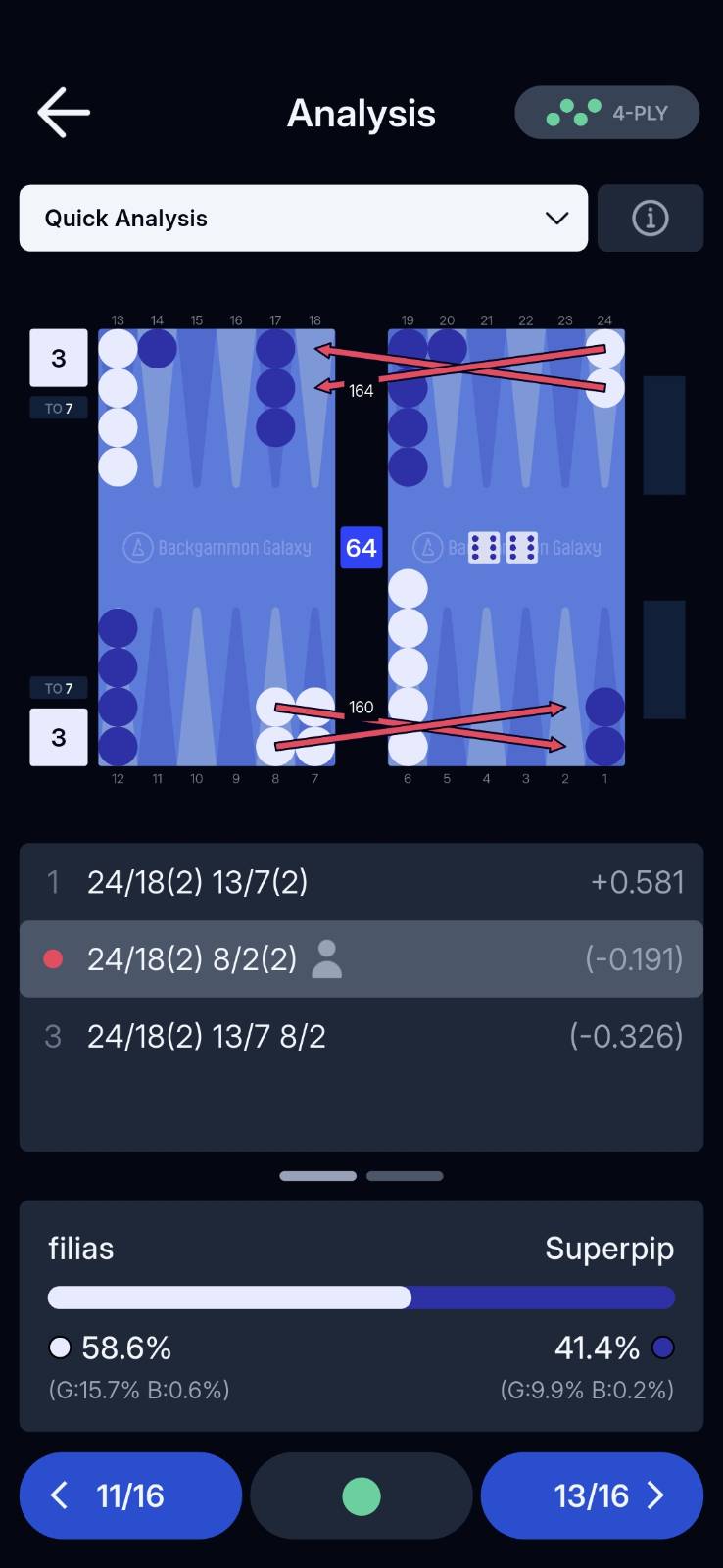
How to play 6-6 early? On roll at 58.6% (G 15.7%), score 3-3 to 7. Engine (4-ply): best is 24/18(2) 13/7(2) (+0.581). I played 24/18(2) 8/2(2), a −0.191 blunder; 24/18(2) 13/7 8/2 was worse (−0.326).
Why the bar point: both plays run the back checkers to 18 (anchoring the opponent's bar point). The difference is the other pair — 13/7(2) makes my own bar point, a key blocking point, while 8/2(2) buries two checkers on the 2-point, far too deep this early and dead for building. Make the bar point, don't bury. See openings.
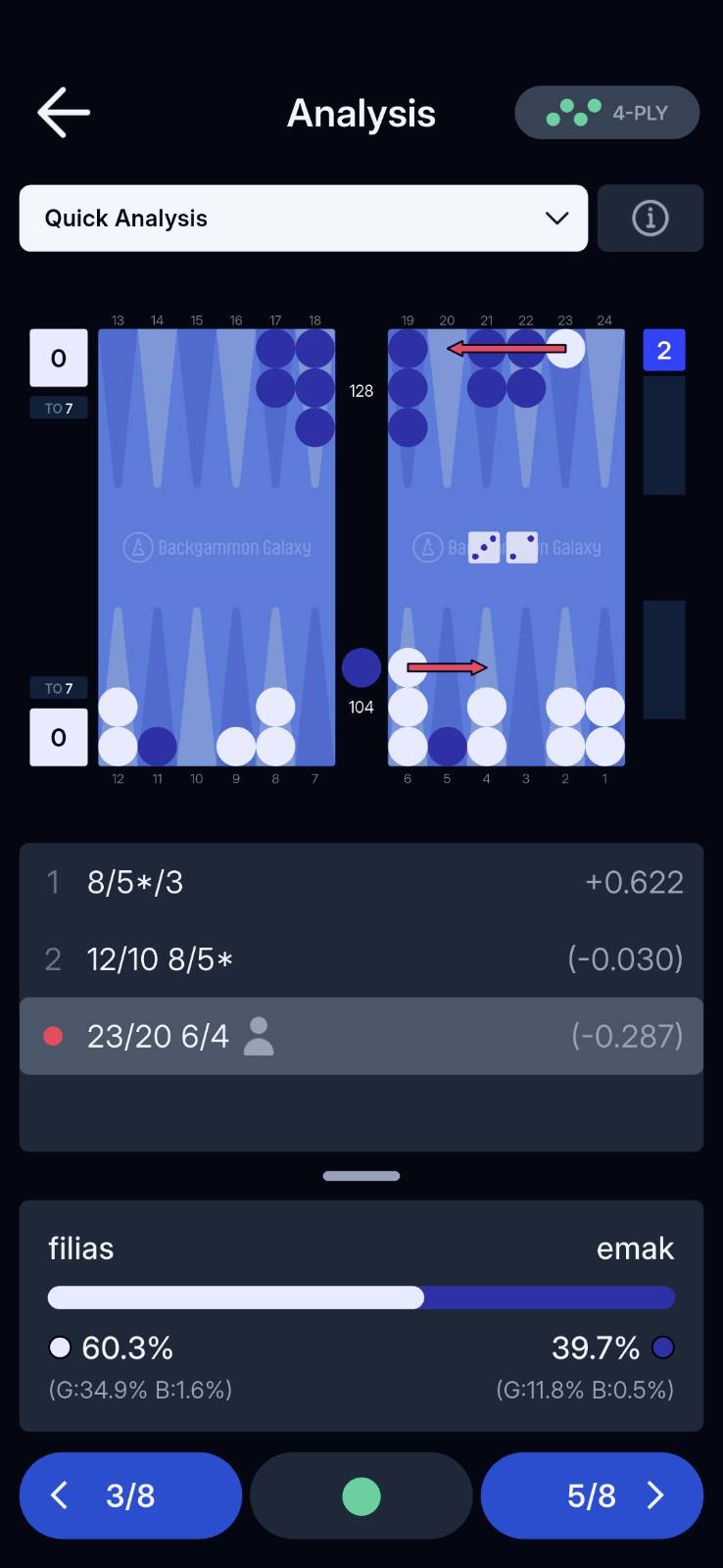
How to play 32? I'm on roll and ahead at 60.3% (G 34.9%). Engine (4-ply): best is 8/5*/3 (+0.622) — hit on the 5-point. I played 23/20 6/4 instead, which is −0.287 (a blunder); even 12/10 8/5* was nearly free at −0.030.
Why hit: hitting on the golden 5-point gains a full tempo, puts the opponent on the bar, and fights for the most valuable point — exactly what I want while already leading with big gammon chances. Running a back checker (23/20) and unstacking (6/4) is passive and throws the hit away. When ahead with a good board, hit and attack. See openings — the 5-point.
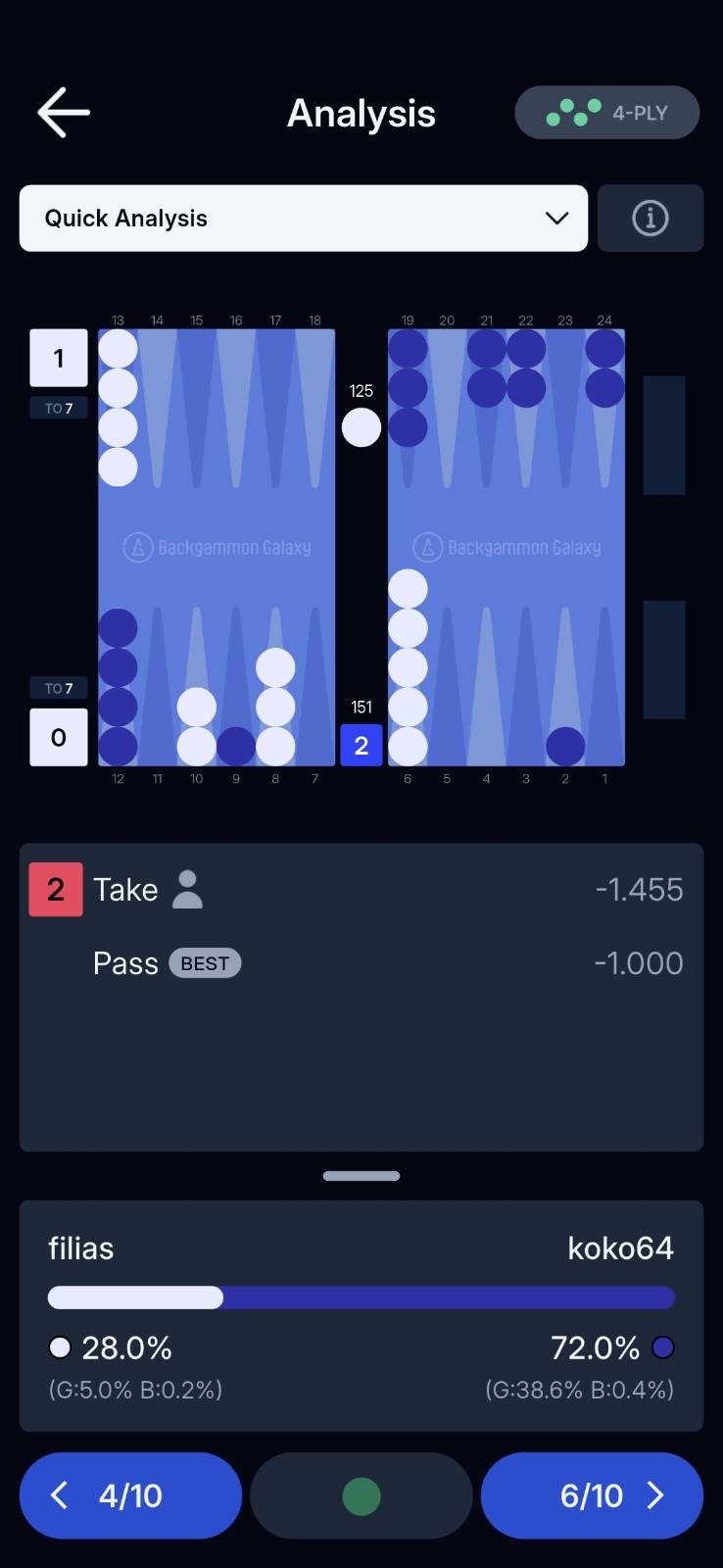
Take or Pass? 7-pt match, opponent doubles to 2. I'm at 28.0% (G 5.0%) vs opponent 72.0% (G 38.6%). Engine (4-ply): Pass is best (−1.000); Take is −1.455, so taking is a 0.455 blunder.
Why drop: 28% wins is already near the borderline, but the opponent gammons 38.6% of the time — at cube 2 those cost 4 points, which pulls take-and-lose equity way down and puts me clearly below the take point. Low wins + heavy gammon danger = easy pass. See take points from the MET.